Thursday, December 10, 2015

DALTON TRUMBO & ME


I met legendary screenwriter Dalton Trumbo back in the late 1970’s. At the time, I was a columnist for the important weekly trade paper, The Hollywood Reporter, which was a bible for everyone in Film & TV. I was writing a series about the Great Old Days in the Film Industry and interviewing men and women whose work had made their mark on our lives.


He was one of the famous Hollywood Ten, and after being accused of being a communist and refusing to give information, had gone to prison in 1950 for contempt of Congress. When he came out no studio would hire him and he took his family to live in Mexico. 

However, the film industry was still eager to make use of his writing talents so, under assumed names, he wrote about 30 screenplays at a meager salary compared to his worth. These included Best Screenplay Oscars for “Roman Holiday” and “The Brave One.”  

When I called Dalton, he expressed surprise that a member of the trade paper that had led the charge against him wanted to feature him. He lived above Sunset Boulevard and invited me over to chat. I waited in the large downstairs drawing room and he came down along one wall seated on an electric stair lift. He was a tiny guy and admitted he was getting a bit frail, but his greeting was hearty and he was agreeable to answer any of my questions about those that had exploited him after he was toppled from his screenwriting pinnacle.

I was expecting some trace of bitterness towards the film industry, but this cheery man seemed to find the entire scenario broadly amusing. In fact, I hardly had to question him; he was ready to tell his version of the great filmmaking days, the good and the bad, and to also give me the names of certain rascals who had betrayed him. When he asked whom else I was interviewing for the series and I mentioned mega-producer Sam Spiegel he roared with laughter. Let me tell you about my last meeting with Mr. Spiegel, he said. And here’s the tale as I recall:

I had been sentenced to prison and I was deeply troubled for having to leave my family with no income flow. It had stopped when I was first accused and, due to the blacklist, no one was any longer hiring me. Now Mr. Spiegel owed me a great deal of money and he had been putting off payment – I assume because he felt that with me behind bars it was pointless to pay up. Oh, yeah! Well, I called him up and said I needed to talk and he agreed to meet me at a distance from the studios, obviously because he didn’t want to be seen with me.

I drove to our liaison point and picked him up, then drove up to the top of Mulholland to a quiet wooded area and stopped. I asked him when he was going to pay me and he gave me the runaround. So I pulled out a pistol, aimed it at him, and said I want the money now, as I do not intend to go off to jail and leave my family penniless. He appeared a bit shocked, but obviously didn't believe I was serious about shooting him. So I told him that it would give me much satisfaction while sitting in prison to know that at least he wasn’t having a great surge in his career and shooting him would probably not add much more to my sentence anyway.

I said firmly, ‘If you don’t go with me to your bank right now and draw out the money I will shoot you.’ We had never liked each other much anyway and at that time I didn’t give a damn whether I got fried for murder as my life and career were ruined. Evidently, he finally realized I was serious and we drove to his bank and he gave me the money.

Needless to say, I did not mention this in my story and after my article came out he called me at the Hollywood Reporter and said he enjoyed it.

About 2 months later, I called Dalton and asked if he would write a column for the Reporter and maybe include some of the fabulous tales he had told me. He said come on over. This time I was ushered into his bedroom. He sat on the bed while I sat in the armchair. He had written the column and read it aloud to me. It’s in the Hollywood Reporter Archive and is a phantasmagoric tale of a nightmarish flight over a magical land. It made no sense to me. I asked him what it meant and he said that’s exactly how it was.

A few months later he died of a heart attack at age 70.

Friday, October 9, 2015

TAMING OF THE SHREW …thinking aloud!


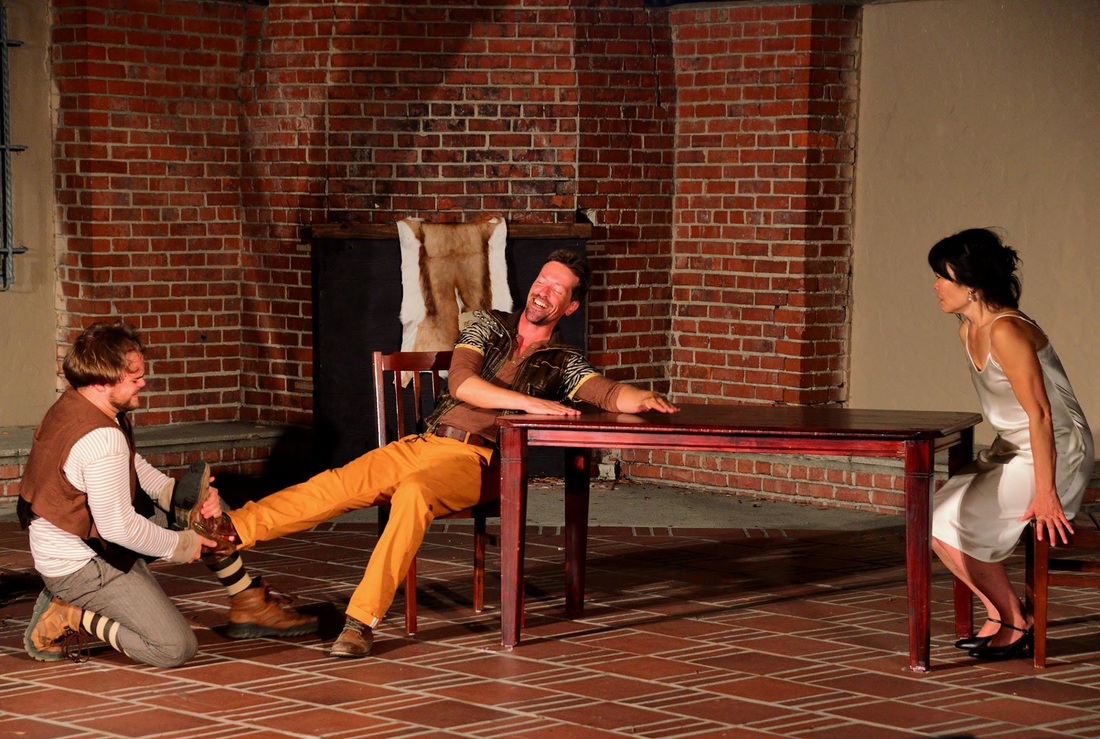
For the second year Lovers & Madmen have presented outdoor Shakespeare in West Hollywood's beautiful Plummer Park and the quality of these shows is first rate. This year it was the famous Battle of the Sexes wherein the beautiful but bad-tempered Kate is being wooed near to death by the audacious and clever Petruchio. The excellent cast, under Bruce Cervi’s forceful direction, are at full throttle and the enthralled audience is full of glee to see this bitch tamed.

The challenge for any production of Shrew is to neutralize the terrible misogyny of the play. Shakespeare might have been having troubles with his wife Anne Hathaway at the time (maybe) but in this romp he certainly lauded a man’s ability, through bodily strength and shrewd psychology, to break a fierce woman’s spirit.

Sorry guys. If you are presenting this play you have to deal with what’s really going on. Petruchio is an adventurer looking for a rich wife and he doesn’t care if she’s fat, old or ugly. So much for a hero! Kate has an annoyingly gorgeous younger sister, who all the men are after, and who is also their father’s precious darling. To make Kate so beautiful (no matter what a character says in the play) causes immediate disbelief. Hey, with her looks and her $$$ there would be a dozen young fortune hunters willing to tolerate her bad moods. After all, what are men’s fists for if not to knock some sense into contrary women. It’s been going on for centuries and Will Shakespeare should be ashamed of himself.
 

At least in Merchant of Venice he gave Shylock a chance to show his side of the argument. Years of contempt, mockery and persecution made him hard. But all Will gives Kate is a really bad temper. 


Breaking her spirit becomes the sport of the play and as I watched this superb production I grieved that they did not try to bring some other focus to it.

It can be done. I saw A. J. Antoon's rambunctious production in Central Park eons ago with Tracey Ullman as Kate and Morgan Freeman as Petruchio and what a match! She gave him as hard knocks as he gave her and in her final Lord & Master monologue she did indeed place her hand under his foot but only to toss him across the stage amid his, and the audiences, roars of laughter.

In this Plummer Park version, beautiful slender Charline Su and handsome virile Joshua Thomas were both in top form playing the traditional battle of dominance we expected. His abuse of her is certainly an effective comeuppance for having such a nasty disposition. However, the punishment does not fit the crime so the laughter at the violence done to her (and also to his servants) revealed an audience that apparently looks at cruelty as just another theatrical device.

I hope Lovers & Madmen will not be discouraged by my snippy comments and will be back next summer, with their excellent company, to bring Will alive again. But please, do not present Titus Andronicus or I will have to picket the venue!

Tuesday, June 16, 2015

MY FATHER ALWAYS SANG FOR ME ...a memoir


Mother & Father, when dating, with a friend


      My father, Bill Murphy, was born in County Cork, Ireland in 1905.  His father was a schoolteacher.  His mother had already given birth to eleven children and my father was number twelve.  A few years later she died giving birth to her thirteenth child.  His stern father did not believe in protecting children from the harsh facts of life and my father’s first memory was of seeing his darling mother lying cold and dead in his parent’s bedroom.  He was two years old.
            When he was about eight he had a dog that he loved, a big old yellow mongrel that followed him home one day.  Then an edict came from the County Cork municipal authorities.  All dogs that were unlicensed had to be destroyed.  My father knew his family could not afford the license fee so it was useless to even ask.  He hid the dog until the final day.  When he saw the official car coming up the street to give out summonses he grabbed the dog and ran to the river.  Years later he laughed as he described the terrible scene, “Dozens of kids like meself, all there drowning their pets so the family wouldn’t get mad at them.”  That was when I realized the Irish always laugh when their hearts are breaking.
            He ran away to sea when he was seventeen and traveled the world in the Merchant Marines.  He met my mother when he was home on leave in County Cork.  She was eighteen and they met at a Halloween party.  He was tall and handsome with red hair and full of jokes.  She was pretty and slim with chestnut hair and a clever quip for all his teasing.  Their courtship was full of laughter and two years later they married.  He stayed at sea until their second child was born.  Then he retired from the Merchant Marines and they moved to England and settled in Romford, a small town outside London.
            When World War Two broke out London was being bombed and mother took the children (now three little girls) away to the country for safety.  My father must have been very lonely and he got involved with a woman he met through friends.  Doris was beautiful and extremely warm and affectionate and she adored my father.  By the time my mother found out my father was having an affair they had decided they could not live without each other.  At the break-up, they were hostile to my mother and left her with an empty house (they took the furniture) and four young children ages ranging from eight years old to six months.
            I was too young to remember any of this and did not consciously meet my father until I was about seven.  I was in boarding school and went to stay with him and Doris and their new baby boy for the Easter holiday.  I loved Doris on sight and when she hugged and kissed me affectionately I was smitten forever.  My father was more formal, nodding and smiling but with no physical contact.  Then the first morning I woke up in their pretty little bungalow I heard him singing.  And I knew then that my father was singing for me.
He had the most beautiful baritone voice I ever heard, then or since.  He sang opera, Irish ballads, American standards.  The house rang with the glory of this music.  Doris would sometimes laugh and cover her ears but I never tired of hearing him.  At night he and I would walk through the dark empty streets and he would sing.  I danced along beside him, running to keep up with his long-legged strides.  Entranced by his voice ringing boldly through the silence. 
      Every year he entered the competition for the Essex County Music Festival and won Best Baritone.  I sat with Doris in the Festival Hall puffed with pride at my father’s glorious gift.  He sang Mozart, Puccini, Gilbert and Sullivan and was clearly the audience favorite.  He always chose to sing far away from the microphone – his voice strong and vibrant, filling the hall in no need of mechanical help.
      After my mother took us to America, when I was thirteen, he dropped out of my life.  I wrote him long letters that were never answered.  Somehow they had decided to cut off that secret family from his past.  Years passed with no word from him but I never gave up writing.  I wrote of our difficult adjustment to our new life.  Of my strange but friendly acceptance at a New York Public school.  Of my oldest sister’s boyfriends.  My younger brother’s troubles with delinquency.  My mother’s marriage to a kind gentle man.  My longing to see them, Dad and Doris and Billy.  No response.
      At the age of eighteen I decided to become an actress and started in Drama School.  I wrote to Dear Dad and Doris that I was about to embark on this theatrical career.  I wanted to be on Broadway, maybe in the movies.  An actress of quality and dedication.  And then he wrote me a letter.  “I would advise you against going into the commercial world of the theatre,” he wrote.  “It is a hard life and the rewards are not worth the suffering you will endure.  There are a lot of talented people who try to make a foothold in that area and never amount to anything.  It’s not worth the hardship so I advise against it.  It’s no life for someone like yourself.  You can do better.”
     I had broken the ice.  The following year I went to stay with them again.  He no longer sang at Festivals and there was no Glee Club at the factory where he was a supervisor.  I asked him to sing the old aria’s and he did, but with apologies for the loss of tone in his voice.  Doris did not care that he no longer sang about the house, but I did.  Before I left for America again I asked him to make a record for me of all his old songs.  “I’ll do it,” he promised.  He had to hire a pianist and go into a recording studio but it did not take him long to do it. 
      The package came when I was living with my best friend in a Brooklyn apartment.  She was a classical-music lover and without telling her who she was hearing I played my father’s record.  It was his voice, but he was right, the vibrant tones were gone.  The glorious voice was thinner and weaker but still it had his magic sound.  We listened to the entire roster of songs and she chucked appreciatively.  “Very good,” she said.  “That’s my father singing,” I confided in her.  She laughed.  “Of course, I knew that.  All you ever talk about is how your father had this lovely voice and always sang for you.”  “Yes,” I said, “And now I have his voice forever.”   
 by Morna Murphy Martell

Tuesday, April 28, 2015

SEA PHANTASY: A WRITERS WORKBOOK by George Fain


The Author of this workbook, George Fain, is a logophile* - a Lover of Words - and in this charming booklet he introduces young people to the delight of expressing oneself beyond the mundane.  


At first he cheerily lists dozens of examples of a series of popular writing expressions, from Allegory through Hyperbole and on to Syllogism. Then he explains how to write freely from ones own imagination, using descriptive words fluently and with great amusement. 


To Fain, writing can be the greatest fun and reading his surrealistic pirate adventure stories shows how free one’s imagination can be. Give this book to your favorite youngster and inspire them to expand into imaginative writing instead of texting in dull shorthand. 


Photo selections are by fashion designer Amber Guidara. For information, email gnf@earthlink.net or call (323) 851-8525.

* Dictionary.com: logophile n. Greek logos – speech; phile – friend/lover.